


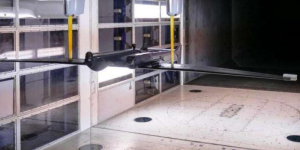

SERPONG, BANTEN—Turkish Aerospace Industry (TAI) is developing the latest generation of Unmanned Aerial Vehicles (UAVs). Currently, this new UAV is being tested at the Indonesian Low Speed Tunnel (ILST) facility of the Aerodynamics, Aeroelasticity, and Aeroacoustics Technology Center (BBTA3) under the Agency for the Assessment and Application of Technology (BPPT) in Serpong, Banten.
Tamer Ozmen, Vice President of Corporate Marketing and Communications at TAI, shared with Anadolu Agency during a visit to BPPT last weekend that the latest generation UAV is expected to enter production in the next 3 to 4 years.
According to Ozmen, the new UAV is equipped with two engines and has a larger payload capacity. “The testing process is currently 80% complete, and the remaining 20% will be finalized in the coming weeks,” Tamer stated.
Tamer explained that BPPT’s collaboration in testing the new UAV is based on their successful experience in developing the Turkish UAV named Anka since 2008. The Anka UAV is now well-experienced in various activities such as counter-terrorism and land and sea reconnaissance, and is used by the Turkish Armed Forces and the National Intelligence Organization. Tamer mentioned that Anka is also operational in Turkey and several other countries. “BPPT played a crucial role in the success of Anka’s development,” Tamer emphasized.
Tamer added that TAI is currently looking for opportunities to collaborate with the Indonesian defense industry. “In November, we will participate in the Indo Defence exhibition in Jakarta, and TAI will bring a full-scale model of the ANKA,” Tamer added.
Currently, TAI’s Anka UAV is participating in a tender with the Indonesian Ministry of Defense for the development of unmanned aircraft in Indonesia.
At the event, Fadilah Hasim, Head of the Aerodynamics, Aeroelasticity, and Aeroacoustics Technology Center (BBTA3) at BPPT, acknowledged that cooperation with TAI in UAV testing has been very beneficial.
Fadilah stated that in 2008, when BBTA3 BPPT started its collaboration with TAI in developing the Anka UAV, unmanned aircraft technology was just beginning to develop. “With the Anka testing, we also had the opportunity to gain experience in studying small UAVs or aircraft with low Reynolds numbers,” Fadilah explained.
Before starting the Anka testing cooperation program, she acknowledged that the database at BBTA3 BPPT was for testing large aircraft, which were well-documented in books and literature. “But aircraft with small wings, which are very sensitive to wind speed, still lacked much database. We had the chance to learn,” she added.
Fadilah explained that the testing facilities at BBTA3 BPPT include the Indonesian Low Speed Tunnel (ILST) wind tunnel, with a testing section measuring 4×3 meters, built by President BJ Habibie using technology from Germany and the Netherlands. “Our wind tunnel is very accurate, with turbulence intensity below 0.1%,” Fadilah said.
Additionally, the wind tunnel has very uniform flow angles and very thin boundary layers. “The ILST wind tunnel is a world-class wind tunnel,” she continued.
Leave a Reply